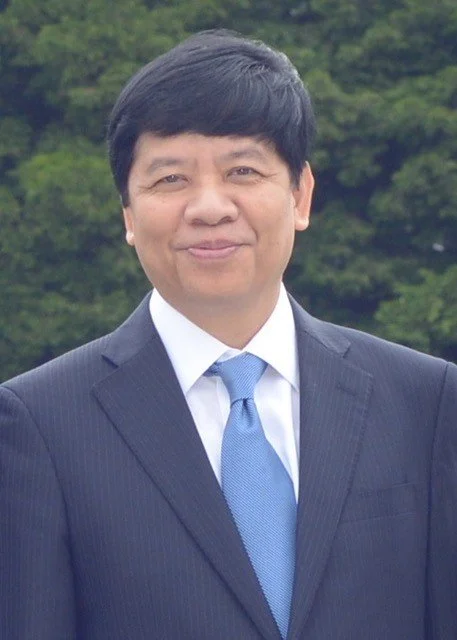
Ambassador Nguyen Quoc Cuong
Foreword
by Ambassador NGUYEN QUOC CUONG
Former Deputy Foreign Minister of Vietnam and Chairman of the National Committee for Overseas Vietnamese (2008-2011, 2019), Former Vietnam’s Ambassador to the United States (2011-2014), and to Japan (2015-2018)
When Sam Van and Sam Korsmoe approached me about writing the Foreword for a book about 25 incredible people over the 40-year history of Đổi Mới (Vietnam’s economic reform policies), I was intrigued. Two questions immediately came to my mind. First, how do they, an Overseas Vietnamese (Viet Kieu) and an American writer, perceive Đổi Mới and why did they decide to write a book about it? Second, will their book provide any added value, given the fact that there have already been so many published books and articles about Đổi Mới over the past 40 years?
I asked them to send me the manuscript of their book, 40 Years of Innovators. I then basically locked myself up for a couple of days to read through all of the 25 profiles. Surprisingly, I discovered that the more stories I read, the more excited I felt about the stories and wanted to keep reading.
I joined the foreign service in 1981 when I was just 22 years old. This was five years before the very first reforms were introduced in Vietnam. In the early years of Đổi Mới, these policy reforms were mostly ideas, but they created the framework for tremendous changes in the country throughout the 1990s, 2000s, and beyond. These reforms set the stage for my work as a career diplomat, especially when I was appointed as Deputy Foreign Minister and then Vietnam’s Ambassador to the United States and after that to Japan. In those capacities, I became well-versed in how to explain Vietnam to foreign leaders, academics, and businesspeople through the lens of Đổi Mới. My prime focus was always on the nation’s economic reform policies and their impacts, not really on the people who carried out the reforms.
In the book, the authors argue that the Đổi Mới policies, when they were first introduced, were just “words on pieces of paper. They meant nothing unless there were people ready to act on these policies.” Therefore, instead of writing about ‘the what’ (explaining what the new policies were) and ‘the how’ (explaining how the policies were implemented), this book is about ‘The Who.’ Or as the authors write, “It’s all about the people who have made Đổi Mới work for the past 40 years.”
After reading all 25 profiles, I couldn’t agree more. And that’s where I find the added value of the book.
On its own, Đổi Mới could not make a difference for Vietnam. The people who took on the “ideas” that emanated from the Đổi Mới policies and turned policy into action are the people who have made a difference for Vietnam. There are millions and millions of Vietnamese and quite a few foreigners who have done this for my country. This book features 25 individuals who have done this quite well.
I know several of the people whose stories are profiled in this book. I could share some of their personal stories, but I didn’t have their full stories. For example, I know rather well the FPT founders, Mr. Truong Gia Binh and their success stories, but I had never heard their start-up story. This was when just six smart, young mathematicians were sharing a single computer to write software in a small room in Hanoi. One of their “Big Dreams” in the beginning was, as Thanh Nam confessed, “to have two computers.” I also know Madame Pham Chi Lan from the Vietnam Chamber of Commerce and Industry (VCCI). She is a popular reformer and “private-sector booster.” However, I knew very little about the “Friday Group.” This was where she and many other intellectuals and business leaders would meet on Fridays to discuss and initiate new ideas or policy initiatives. They then tried to convey these ideas and initiatives to top-level policy makers in order to make changes in the very early days of Đổi Mới. In another example, I came to know Don Lam 20 years ago when I was a Deputy Head of Mission at the Vietnam Embassy in Canada. We crossed paths many times at different international business forums and summits with Vietnamese and foreign dignitaries, but I had no idea of the noble work of the VinaCapital Foundation. It has helped save more than ten thousand children with congenital heart defects as well as many other humanitarian programs throughout the country.
I can go on and on reciting the same kind of exciting examples from the other profiles in the book. Instead, I will leave it to you to discover for yourself the incredible stories of these 25 remarkable people. They came from diverse backgrounds and various countries, but they shared the same goal: to be part of the Đổi Mới process in Vietnam. In that long journey, they dared to make a difference for Vietnam and they all succeeded. They thrived, and they contributed in different ways to the remarkable economic and social growth of Vietnam over the past 40 years.
But their stories are not just about business success. I was also amazed to discover that they all have fallen in love with Vietnam, no matter where they come from. Even the foreigners in the book. Bradley Lalonde, who set up the first American bank in Vietnam in 1986, now calls Vietnam his permanent home. Fred Burke, a lawyer with Baker McKenzie, “has no plan to return to America.” Ken Atkinson, who set up the very first foreign chamber of commerce in Vietnam (BritCham), was proud to be awarded Vietnamese citizenship No# 000001 in 2018 and the Offer of the Order of the British Empire (OBE) four years later. You may wonder why they are so enamored with Vietnam. Their answer to that question is very simple. Vietnam has stolen their hearts because my country, together with the Đổi Mới policies, has helped them find the very true meaning of their lives. This is to make a good living and have a happy life for themselves, their families, and their colleagues. It is also to help the community and make a difference for the country which they now consider to be their second home.
What’s next for Vietnam?
Vietnam is entering a new stage of reform. Some people are calling it Đổi Mới 2.0. New revolutionary policies and ideas have been introduced such as the Era of the Nation’s Rise, Resolutions 68 for the private sector, Resolution 57 on science and technology, and other policies. They all have one very ambitious goal: to make Vietnam a developed and high-income country by the year 2045. Again, these new policy initiatives will need many, many people to take them on, adjust them, expand and retract them, and ensure that they are addressing the problems for which they were intended.
It is my great honor to write this Foreword. May these pages not only celebrate the individuals profiled, but also inspire the next generation to carry forward the spirit of innovation, resilience, and partnership that has defined Vietnam’s Đổi Mới journey since 1986. It is my firm belief that this will continue for the next 20 years to 2045. With Đổi Mới 2.0 as a guide, Vietnam will continue to grow and prosper.
Ambassador Nguyễn Quốc Cường
September 2025
Hanoi, Vietnam